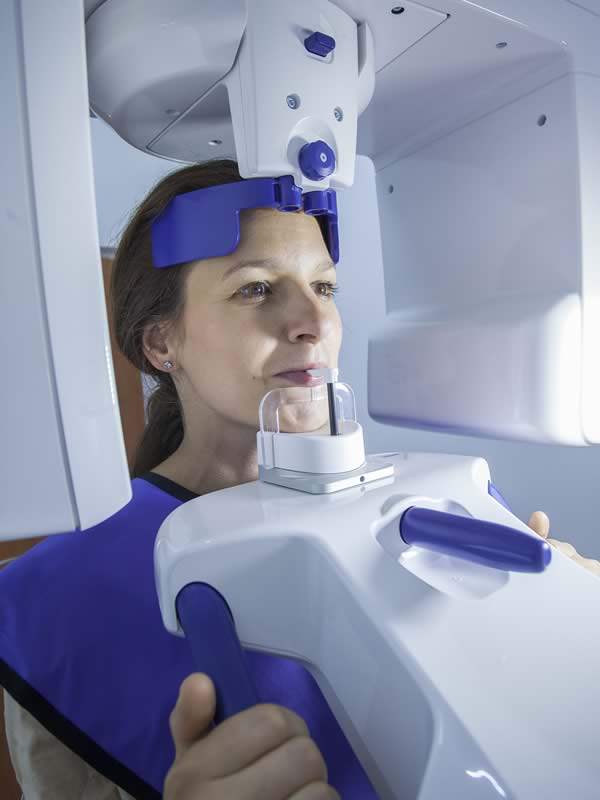
You have probably had a dental X-ray before, but you may not have come across a CBCT scanner. These scanners are now becoming an increasingly useful part of modern dental care, especially when a dentist needs a much more detailed picture of what is happening below the surface of the gums and especially information that a standard x-ray may not provide.
CBCT stands for cone beam computed tomography. The name sounds rather complicated, but the basic idea is fairly straightforward. Instead of producing a single flat image, a CBCT scan takes a series of images from different angles and combines them together to create a three-dimensional picture.
This will enable your dentist to understand in more detail, the situation with your teeth, jawbone and the surrounding structures.
A conventional dental X-ray is very useful, but it is essentially a two-dimensional picture. Different structures can overlap one another, which can sometimes make it difficult to see exactly what is happening.
A CBCT scan allows the dentist to look at the area from different directions and angles. They can examine the image in sections and build up a much clearer picture of the overall anatomy. This can be particularly useful when planning treatment where knowing the exact position of structures is important.
Not everybody will need to have a CBCT scan at our Staines dental practice. Your dentist will decide whether it is appropriate for your particular situation.
One of the best-known uses of CBCT scanning is in dental implant treatment.
Before placing a tooth implant, our dentist will need to know about the amount and shape of bone available in the area to place them into. They also need to be aware of important structures such as nerves and the sinuses.
A CBCT scan can provide a much clearer picture of this than a standard X-ray can. It can prove very useful with planning where an implant should be positioned and whether any additional treatment might be needed beforehand. Planning is a vital part of implant treatment. The more information we have before starting, the better we can plan the procedure.
CBCT scans can also be especially useful when a tooth is particularly difficult to assess using ordinary X-rays. This can happen with teeth which have unusual roots, teeth which are impacted or teeth which are positioned in a complicated way.
Wisdom teeth are a good example of this. If a wisdom tooth is close to an important nerve, a 3D scan can help the dentist understand the relationship between the tooth and the nerve before deciding how it should be treated.
It doesn’t necessarily mean that treatment will be more complicated, but having the extra information to hand can make the situation much clearer.
CBCT scanning can also sometimes be helpful when planning or investigating root canal treatment at the Clarence Dental Practice in Staines.
The root canal system inside a tooth is not always as simple as it appears on a conventional X-ray. Some teeth may have additional canals or unusual root shapes, and previous root canal treatment can sometimes leave a dentist trying to work out exactly what has happened inside the tooth. Naturally, it is better if we have the fullest picture possible before starting the treatment.
Again, this does not mean that every root canal patient needs a CBCT scan. It is more likely to be considered when a standard examination and X-rays have not provided enough information.
CBCT scanners can also be used to examine the jawbone and other structures around the teeth.
They may be useful when investigating certain jaw problems, facial injuries or abnormalities, and can sometimes assist with assessing the temporomandibular joints, which are the joints that connect the jaw to the skull. They can also help dentists and specialists understand the position and extent of certain lesions or other abnormalities when a more detailed view is needed.
The scan itself does not tell your dentist everything about a condition, of course. It is one piece of information which is considered alongside your symptoms, examination and other tests.
The scan itself is generally quick and straightforward.
The patient sits while the machine rotates around their head. You will need to remain still while the images are being taken. The process does not involve anything being placed inside the mouth, unlike some conventional dental X-rays. This is good news for those that find having the x-ray plates in their mouth makes them feel uncomfortable.
It is a pain free procedure that is suitable for even the most nervous patient.
CBCT does use X-rays, so there is exposure to radiation as there is in a conventional x-ray. However, the amount used is controlled and modern equipment is designed to obtain the necessary information while keeping the dose as low as reasonably achievable. Some patients seem a little concerned that the dentists and staff move away during this time, but this is due to the number of times they carry the scans out over a period of time. Each dose of radiation is very small, but can accumulate. For a one off scan, there should be no problems at all for the patients.
If you are pregnant or think you may be pregnant though, it is important to let our dentist know before any X-ray examination, whether a standard one or a CBCT scan.
If you have been considering dental implants or need to have a root canal procedure, you can be sure that we take good care to ensure that these are carried out safely and effectively, using our CBCT scanner where required. If you would like to book an appointment with us, you can call the Clarence Dental Practice today on 01784 463 695.


Address: 21a Clarence Street, Staines upon Thames, Surrey, TW18 4SU
Location Map
